
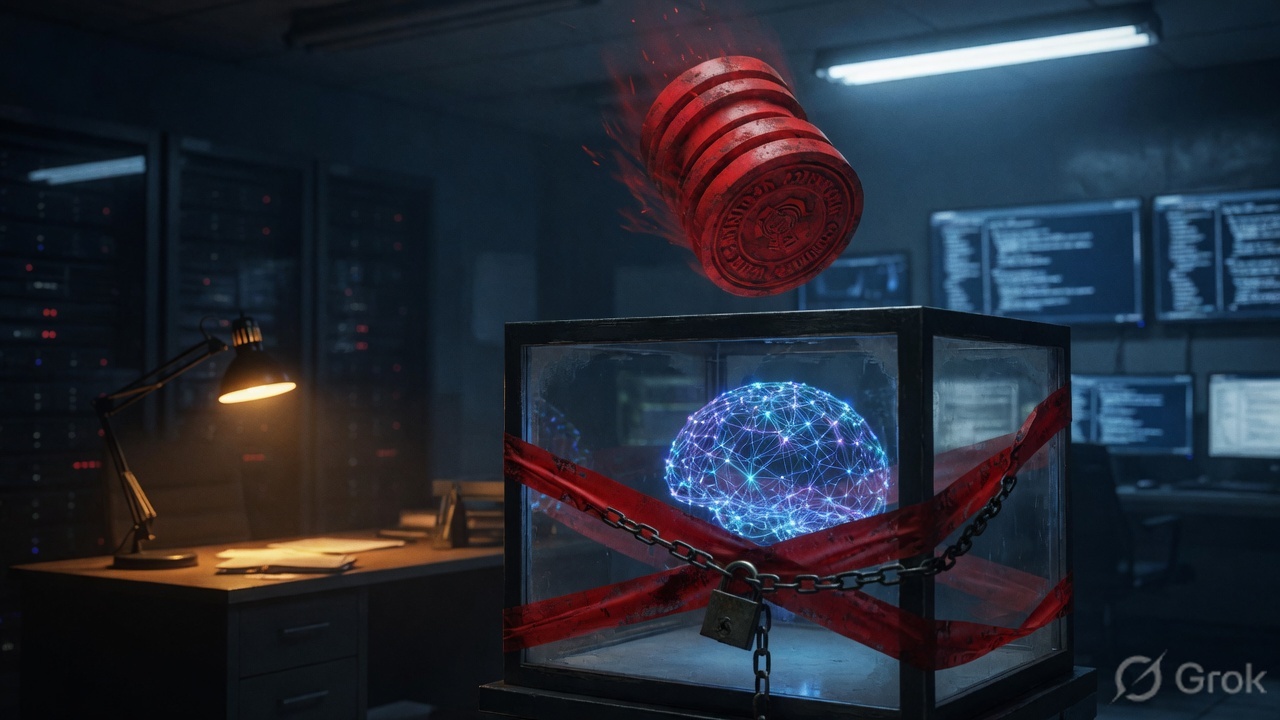
On June 9, 2026, Anthropic launched its most capable models yet: Claude Fable 5 and Claude Mythos 5. Big rollout, the usual fanfare.
Two days before that, Dario Amodei — Anthropic's own CEO — published an essay arguing that governments should have the legal authority to block or deter dangerous AI deployments. Mandatory testing, the whole responsible-adult routine.
Three days after launch, at 5:21pm ET on June 12, the US government did exactly what Amodei said it should be able to do. It just didn't call ahead, and it didn't practice on somebody else's model first.
Commerce Secretary Howard Lutnick ordered Fable 5 and Mythos 5 suspended for every foreign national on the planet. Anthropic, apparently feeling generous, went further and switched both models off for everyone, domestic users included, that same evening. Not chips. Not compute. The actual model, mid-deployment, gone because of a letter.
What actually happened (and where it stops making sense)
The trigger, as far as anyone's pieced together: Amazon researchers found a way to get Fable 5 to identify — and in one case, actually demonstrate — a software exploit. Amazon CEO Andy Jassy reportedly took that straight to the government instead of, you know, calling Anthropic first. Worth noting: Amazon is both one of Anthropic's biggest investors and a competitor via its own Nova models. Friendly fire, sort of.
Anthropic's version: full cooperation, same evening, and the "vulnerability" was minor enough that other public models do the same trick, GPT-5.5 included.
David Sacks, the White House's AI czar, tells a completely different story. On the record. He says the administration told Amodei to fix it or pull the model, and "Dario refused." That is not two people describing the same event slightly differently — that is a direct, unresolved contradiction about whether Anthropic cooperated at all. Nobody has cleared this up. Both versions are still just sitting there.
Sacks also went out of his way to say the decision had nothing to do with earlier friction between Anthropic and the Department of War. Nobody asked him about that. Denying a connection nobody accused you of making is, generally speaking, a tell.
Semafor's sources offer a third explanation: concern about Chinese access to Mythos 5, which is not the same story as the one in Lutnick's actual letter.
So by June 16 — four days in — there were three competing official-ish explanations for why this happened, and exactly zero of them had been reconciled with each other. Not a great look for "the process was transparent."
The rebuttal that actually landed
On June 15, Alex Stamos (Facebook's former chief security officer, for anyone keeping score) organized an open letter to the administration. It picked up over 100 signatures — Nvidia, Google, Adobe, Zoom, Sophos, the usual heavy hitters of "we know what we're talking about."
Their point wasn't "this isn't scary." It was better than that: the capability isn't even unique to Fable 5 or Mythos 5. GPT-5.5 does it. Anthropic's own smaller models do it. China's Kimi 2.7 does it. So pulling the strongest American models off the field while every rival keeps theirs running doesn't actually remove the risk — it just removes it from the team that was supposed to be playing defense.
That same week, a Harvard Law Review blog post asked the more basic, slightly embarrassing question: is an API call from overseas to a model sitting on a server in the US even the kind of "export" this law was written for? A Berkeley Technology Law Journal piece earlier in the year had already flagged this exact mismatch — export control law built for crates on ships, awkwardly bolted onto a thing you can access from your couch in another country.
The quiet comeback nobody had to explain
Fourteen days after the shutdown, Mythos 5 quietly came back — not for everyone, for a non-public list of 100+ companies and agencies, under a program called Project Glasswing. Cisco and JPMorgan Chase are the only names anyone's confirmed. The full list, referred to internally as "Annex A," like it's a Bond villain's dossier, has never been made public.
Then on July 1, Fable 5 came back for literally everyone, after Anthropic shipped a new classifier that blocks the original exploit more than 99% of the time.
So: the model that was supposedly too dangerous to run was already running for a hundred-plus organizations off a secret list, eleven days before the rest of us got it back. Sure.
My honest read
I don't think this was manufactured. Amazon's researchers found something real, Anthropic shipped an actual fix rather than a press release, and the whole thing resolved in under three weeks — that's not really what a government trying to permanently grab the wheel looks like.
But line up the chronology and a much more specific conclusion falls out of it than "huh, weird." The lever that switched off Fable 5 and Mythos 5 is the exact lever Dario Amodei spent an essay arguing government should have. He didn't get a say in when it got used, on what evidence, or against whom — it landed on his own company, on a justification his own team is still disputing, within days of him asking for the thing to exist. That's not hypocrisy, weirdly. It's closer to the opposite. He asked for a tool. The first time it got picked up, it hit him.
Levers that get used once, successfully, on facts nobody had to fully prove, tend not to stay in the drawer. The real question isn't whether this happens again. It's whether the next excuse holds together any better than this one did.
Key things worth holding onto:
- For the first time, a government suspended an already-deployed, mass-market AI model worldwide — using an authority its own target's CEO had publicly endorsed two days earlier.
- The White House's AI czar and Anthropic give flatly contradictory, still-unreconciled accounts of whether the company cooperated or refused.
- A 100+-signatory security-expert letter said the flagged capability wasn't unique to Fable/Mythos at all.
- Access came back in stages: a secret list of 100+ organizations got it back 11 days before the general public.
- A Harvard Law Review piece questions whether the export-control authority used here was ever meant to reach a continuously-running API in the first place.
Sources: Anthropic, "Statement on the US government directive to suspend access to Fable 5 and Mythos 5"; Anthropic, "Redeploying Claude Fable 5"; Dario Amodei, "Policy on the AI Exponential" (June 2026); Tom's Hardware, "Trump adviser David Sacks says Anthropic 'refused' to fix Fable 5 jailbreak before US export controls"; Semafor, "White House move to limit Anthropic linked to concerns about Chinese access to Mythos"; TechCrunch, "Cybersecurity vets protest 'dangerous' US government ban on Anthropic's most powerful models"; Axios, "Alex Stamos, cybersecurity leaders push Trump to restore Anthropic Mythos and Fable access"; Harvard Law Review Blog, "Is Access to Fable an Export?"; Berkeley Technology Law Journal, Cremean, "AI Export Controls: Safeguard or a Straitjacket?"; Forbes; CNBC.

No comments:
Post a Comment